
8 min read

The Reliability Math: What a Year of Network Incidents Really Costs an AI Cloud — and How Hedgehog Changes the Equation

The Reliability Math: What a Year of Network Incidents Really Costs an AI Cloud — and How Hedgehog Changes the Equation

AI Cloud Business Planning Playbook Series — Part 7

For AI cloud builders, network reliability is not a back-office concern. It is a P&L line item, sized in millions of dollars per cluster per year. Most AI cloud business plans dramatically understate it — because they rely on generic data center uptime statistics that were never designed to describe what actually happens inside GPU fabric at scale.

This post builds the reliability case from the ground up using primary sources: Meta's published Llama 3 training data, the Uptime Institute's 2024 and 2025 outage reports, and field data from large-scale AI cluster operators. The result: a 1,024-GPU B200 cluster running conventional DIY networking is exposed to roughly $2.8M per year in network-attributable lost revenue. A Hedgehog-based cluster reduces that exposure by more than 98% — delivering over $2.77M in incremental EBITDA annually on the reliability line alone, before performance, security, or operations savings are counted.


Why Conventional Outage Statistics Mislead AI Cloud Builders

The Uptime Institute's 2025 Annual Outage Analysis reports that IT and networking issues account for 23% of all impactful outages, and that roughly half of all data center operators experienced at least one impactful outage in the past three years. A back-of-envelope calculation from those numbers suggests an annual network outage probability of about 3.8%.

That number is technically accurate — and operationally useless for AI cloud builders. Uptime's definition of an "impactful outage" is a recorded, significant event at the facility level. It excludes the constant lower-grade network disruptions that define the AI training and inference experience: NCCL hangs, NVLink errors, fabric congestion, miswired rails, ECMP imbalance, optical transceiver flaps, and silent stragglers.

For AI workloads — especially synchronous distributed training — those "lower-grade" events are not lower-grade at all. A single bad link can stall thousands of GPUs. A single congested ECMP path can cut effective throughput in half. The synchronous nature of distributed training makes the entire cluster only as reliable as its weakest network element.

To size this honestly, you need cluster-level data from someone actually running large GPU clusters. Meta published exactly that.


What Meta's Llama 3 Paper Actually Tells Us

In The Llama 3 Herd of Models (Dubey et al., 2024), Meta documented 54 days of pre-training on a 16,384-GPU H100 cluster. The numbers are unambiguous:

Metric Value
Cluster size 16,384 H100 GPUs
Observation window 54 days
Total interruptions 466
Planned interruptions 47
Unexpected interruptions 419
Average frequency One unexpected interruption every ~3 hours
Effective training time >90% (achieved via heavy automation)


The interruption breakdown reveals the network's role:

Root cause Count % of unexpected
GPU failures (incl. NVLink) 148 30.1%
HBM3 memory 72 17.2%
GPU SRAM 19 4.5%
GPU system processor 17 4.1%
Network switch + cable 35 8.4%
Network adapter / NIC (within 41.3% "other") ~3–5%
Software / silent data corruption (within 41.3% "other")
CPU 2 0.5%


A separate Meta study referenced in NVIDIA's DGX SuperPOD documentation found that network configuration errors alone caused 10.7% of significant GPU job failures.

Combining the clearly network-attributable events — switches, cables, NICs, NVLink fabric, and configuration — roughly 12% of all unexpected interruptions are network-caused. At Meta's scale, that is about 50 network incidents over 54 days, or approximately one network-attributable interruption every 26 hours on a 16,384-GPU cluster.

Normalizing to a Per-GPU Rate

50 incidents ÷ (16,384 GPUs × 54 days) = 5.7 × 10⁻⁵ network incidents per GPU per day

Annualized: ~20 network incidents per 1,000 GPU-years

This rate scales linearly with cluster size, consistent with field data published by ByteDance (MegaScale, 2024) and SemiAnalysis's 100,000 H100 cluster reliability analysis (2024).

Applied to common cluster sizes:

Cluster size Expected network incidents / year
256 GPUs 5
512 GPUs 10
1,024 GPUs 20
2,048 GPUs 41
4,096 GPUs 82
8,192 GPUs 164

The incident rate scales linearly with cluster size. A 16K-GPU cluster does not experience "the same" network reliability as a 1K-GPU cluster — it experiences 16× the incident rate.


What Each Incident Actually Costs: MTTR by Failure Type

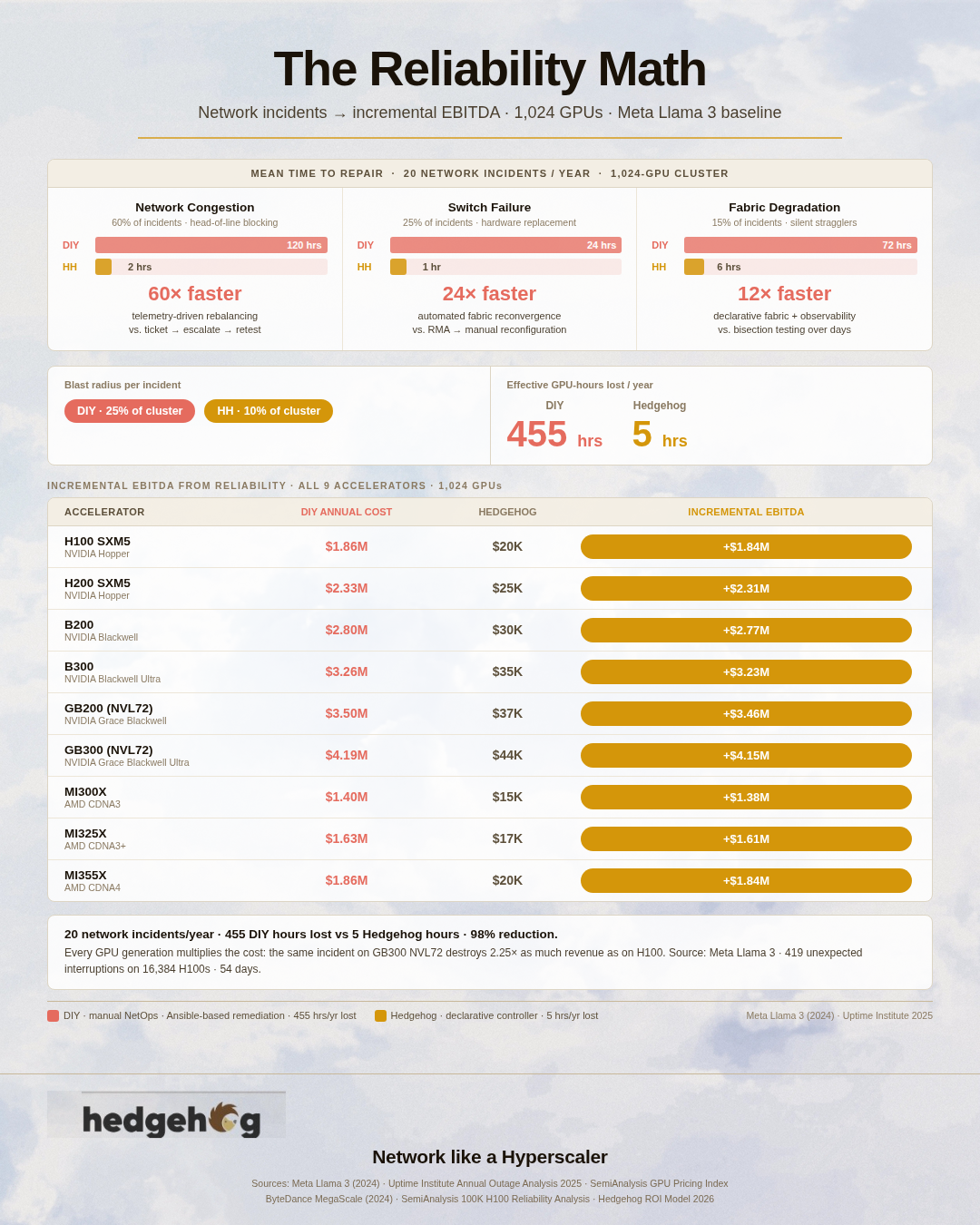
Network incidents are not monolithic. Three distinct failure categories have meaningfully different mean time to repair (MTTR) profiles — and Hedgehog affects each differently.

1. Network Congestion Events

DIY MTTR: 120 hours (5 days) Hedgehog MTTR: 2 hours

The Llama 3 paper devotes substantial attention to congestion debugging: head-of-line blocking in deep-buffer core switches, ECMP imbalance across leaf-spine fabrics, and NCCL tuning. Meta's team built proprietary tools (NCCL flight recorder, straggler detection) precisely because root-causing these issues against vendor-validated fabrics takes days, not hours. The Uptime Institute's 2024 Annual Outage Analysis reports that 80% of operators believe their most recent significant outage could have been prevented with better processes — a tacit acknowledgment that visibility, not hardware, is the binding constraint.

Hedgehog's declarative, telemetry-rich open fabric exposes congestion at the flow level in real time. The remediation loop collapses from "open a ticket, escalate, instrument, change config, retest" to "the controller already saw it and rebalanced."

2. Switch Failures

DIY MTTR: 24 hours Hedgehog MTTR: 1 hour

Hardware switch failure is the most straightforward category — and the one where vendor RMAs and physical replacement set a floor on recovery time. The 24-hour DIY figure assumes well-staffed operations with on-site spares; it can run longer without that. Hedgehog's automated fabric reconfiguration absorbs single-switch failures without operator intervention; the 1-hour figure reflects the time to physically swap and provision the replacement.

3. Fabric-Wide Performance Degradation

DIY MTTR: 72 hours (3 days) Hedgehog MTTR: 6 hours

This is the failure class AI cloud builders dread most: a slow leak that does not trip an alarm. Symbol errors on a single cable that exceed thresholds, silent stragglers dragging down All-Reduce performance, or miswired rails that break locality without triggering an outright fault. The Llama 3 paper describes the painstaking process of identifying these via NCCL flight recorder traces — a process Meta invested quarters of engineering time to automate.

Hedgehog's fabric telemetry surfaces these as first-class events. MTTR drops from days of bisection testing to a single guided shift.

Blast Radius Matters as Much as MTTR

There is a second axis where Hedgehog changes the economics: blast radius — what fraction of the cluster is impacted by each incident. In monolithic vendor fabrics, a misconfiguration or congestion event often propagates broadly because there is no clean isolation boundary between pods or rails.

  • DIY blast radius: 25% of cluster impacted per incident (average)
  • Hedgehog blast radius: 10% of cluster impacted per incident (average)

This reflects the structural difference between a monolithic vendor stack and a declarative, intent-driven fabric where fault domains are explicit and enforced.


Effective Hours Lost per Year

Applying the incident rate, MTTR mix, and blast radius to a 1,024-GPU cluster:

Effective GPU-hours lost = Annual incidents × (each incident type's MTTR × blast radius), summed across incident types

With 20.5 annual incidents distributed 60% congestion / 25% switch failure / 15% fabric degradation:

Scenario Effective GPU-hours lost / year % of available hours
DIY 455 hours 5.2%
Hedgehog 5 hours 0.06%


That 450-hour gap is the reliability EBITDA opportunity. Multiplied by the hourly revenue rate and cluster size, it becomes a concrete annual figure.


Incremental EBITDA from Reliability, Across All Nine Accelerators

The annual reliability cost is calculated as:

Annual reliability cost = Effective hours not billable × Bronze $/hr × 1,024 GPUs

The incremental EBITDA is the difference: how much more revenue a Hedgehog-based operator retains annually versus a DIY operator running the same hardware at the same hourly rates.

Accelerator Architecture Bronze $/hr DIY Annual Reliability Cost Hedgehog Annual Reliability Cost Incremental EBITDA
H100 SXM5 NVIDIA Hopper $4.00 $1,864,090 $19,732 $1,844,357
H200 SXM5 NVIDIA Hopper $5.00 $2,330,112 $24,666 $2,305,446
B200 NVIDIA Blackwell $6.00 $2,796,134 $29,599 $2,766,536
B300 NVIDIA Blackwell Ultra $7.00 $3,262,157 $34,532 $3,227,625
GB200 (NVL72) NVIDIA Grace Blackwell $7.50 $3,495,168 $36,998 $3,458,170
GB300 (NVL72) NVIDIA Grace Blackwell Ultra $9.00 $4,194,202 $44,398 $4,149,804
MI300X AMD CDNA3 $3.00 $1,398,067 $14,799 $1,383,268
MI325X AMD CDNA3+ $3.50 $1,631,078 $17,266 $1,613,812
MI355X AMD CDNA4 $4.00 $1,864,090 $19,732 $1,844,357

(1,024 GPUs × Bronze $/hr × effective hours lost per year)

Three observations from this table.

Reliability EBITDA scales directly with GPU price. As each successive generation commands higher hourly rates, every hour of downtime becomes more expensive to absorb. The same underlying network incident on a GB300 NVL72 cluster destroys 2.25× as much revenue as the same incident on an H100 cluster. Every hardware refresh cycle makes the reliability investment more economically compelling, not less.

Per-incident costs are large when fully loaded. On a 1,024-GPU B200 cluster earning roughly $6,300 per hour of full utilization, a single fabric-wide performance degradation event averaging 72 hours at 25% blast radius costs approximately $115,000 of revenue — for one incident. The same event on a Hedgehog cluster: approximately $1,900. At 20 incidents per year, the compounded difference defines the margin gap between a viable and a marginal AI cloud business.

AMD clusters face the same exposure. The reliability mechanics are identical regardless of GPU architecture — network incidents are a fabric property, not a GPU property. An MI300X operator loses $1.4M per year to network-attributable downtime under DIY networking, with $1.38M of that recoverable through better fabric architecture.


How the Reliability Savings Combine with Other EBITDA Drivers

The reliability savings above are calculated at Bronze-tier pricing — the same rate for both scenarios — to isolate the pure reliability contribution to EBITDA. In practice, a Hedgehog-based cluster that achieves the Hedgehog MTTR profile also qualifies for Silver-tier ClusterMAX ratings (covered in the Sell Math post), adding a 33% revenue premium on top of the reliability recovery.

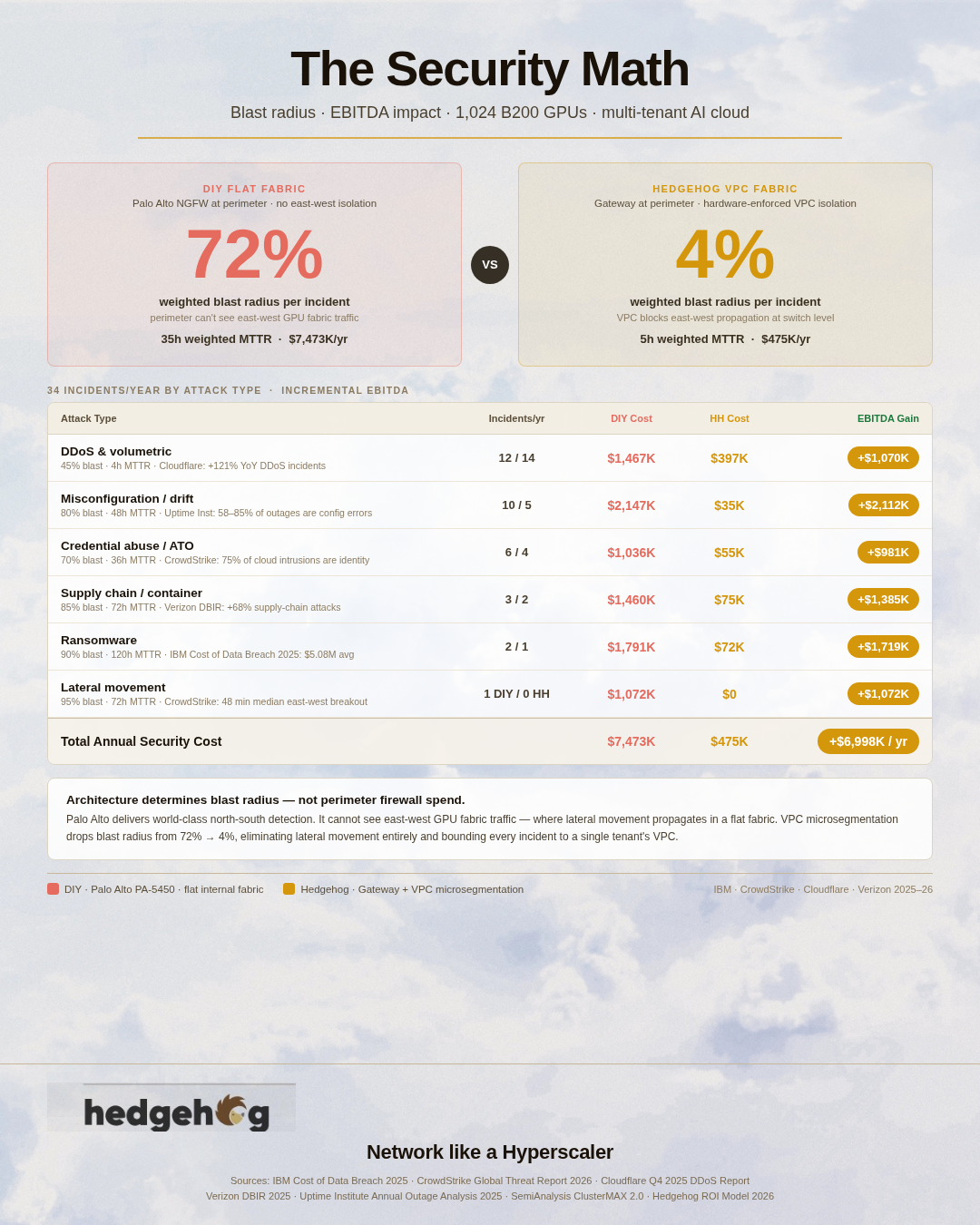
Reliability is also one of three major EBITDA contributors from the network architecture decision. The Performance Math post covers the MFU penalty that costs DIY clusters an additional $5–12M per year. The Security Math post covers the blast-radius cost of lateral movement events. Together, reliability, performance, and security represent the core of the incremental EBITDA a Hedgehog-based operator earns versus a DIY operator on equivalent hardware.


What This Means for AI Cloud Builders

Reliability is not a Tier 3/Tier 4 facility checkbox. The data center can be perfect; the fabric inside it is what dominates AI workload availability. Meta's clusters live in some of the best-run facilities on the planet and still see network-attributable interruptions at the rates documented above.

The relevant uptime metric is not 99.99%. A 99.99% uptime claim allows 53 minutes of downtime per year. The Llama 3 data shows that network-caused interruptions alone consume hundreds of effective GPU-hours annually on a properly scaled cluster running DIY networking. The real range for AI clouds is 95–99% effective uptime. Closing that gap is where the reliability EBITDA lives.

Every additional GPU dollar amplifies the cost of network unreliability. As B200 deployments displace H100 fleets and future generations push hourly pricing further, the proportional revenue at risk from each fabric incident keeps rising. Network reliability is the single highest-leverage investment in AI cloud unit economics — and it compounds with each hardware refresh cycle.


Model Your Own Scenario

Every cluster is different. GPU type, cluster size, incident rate assumptions, and operational staffing levels all affect the reliability EBITDA calculation. The Hedgehog AI Cloud Business Planning Playbook (available at hedgehog.cloud/playbook) lets you model reliability alongside all six dimensions of AI cloud economics — design, procurement, time-to-GPU-value, operations, performance, reliability, and security — at any cluster size from 64 to 8,192 GPUs.

The model is available as both a web-based wizard and a downloadable Excel workbook with every formula visible and every assumption editable. If your incident rate assumptions, MTTR estimates, or GPU pricing differ from the defaults used here, the model is built to reflect your actual situation.


Sources

  • Dubey, A. et al. (Meta AI, 2024). The Llama 3 Herd of Models.Table 5, root-cause categorization of 419 unexpected training interruptions across 16,384 H100 GPUs over 54 days.
  • Uptime Institute (2025). Annual Outage Analysis 2025. 23% of impactful outages attributed to IT/networking; 50% of operators reported at least one impactful outage in the past three years.
  • Uptime Institute (2024). Annual Outage Analysis 2024. Network-related issues identified as the largest single cause of IT service outages; 80% of operators believe most recent significant outage was preventable.
  • Uptime Institute (2024). Global Data Center Survey 2024. 54% of significant outages cost more than $100K; 20% cost more than $1M.
  • Patel, D. and Nishball, D. (SemiAnalysis, 2024). 100,000 H100 Clusters: Power, Network Topology, Ethernet vs InfiniBand, Reliability, Failures, Checkpointing. Cluster-scale reliability characteristics for hyperscale AI training.
  • Jiang, Z. et al. (ByteDance, 2024). MegaScale: Scaling Large Language Model Training to More Than 10,000 GPUs. Failure frequency analysis at production scale; consistent with Meta incident rate normalization.
  • NVIDIA. DGX SuperPOD Reference Architecture. Network configuration errors documented as causing 10.7% of significant GPU job failures.
  • SemiAnalysis (November 2025). ClusterMAX 2.0 Rating Framework. Tier classification methodology; Bronze-tier pricing used as the reliability cost baseline.