
9 min read
The Security Math: Why Multi-Tenant GPU Clouds Need a Smaller Blast Radius — and What It's Worth
Marc Austin : May 22, 2026
AI Cloud Business Planning Playbook Series — Part 8
When you build a multi-tenant GPU cloud, you are operating shared infrastructure that processes some of the most sensitive compute workloads in your customers' businesses — model training, fine-tuning, inference on proprietary data. Each tenant trusts that their workload is isolated from every other tenant's. The network architecture you choose either makes that isolation real or leaves it as a promise you can't keep.
This post quantifies what that architecture choice is worth. It estimates the number and type of attacks a multi-tenant GPU cloud should expect each year, using 2025–2026 threat intelligence from IBM, Cloudflare, Verizon, CrowdStrike, and Uptime Institute. It then walks through how two different architectural approaches — a traditional perimeter firewall on top of a flat internal fabric, versus Hedgehog's VPC-isolated open fabric — handle those incidents differently. And it translates the difference into incremental annual EBITDA.
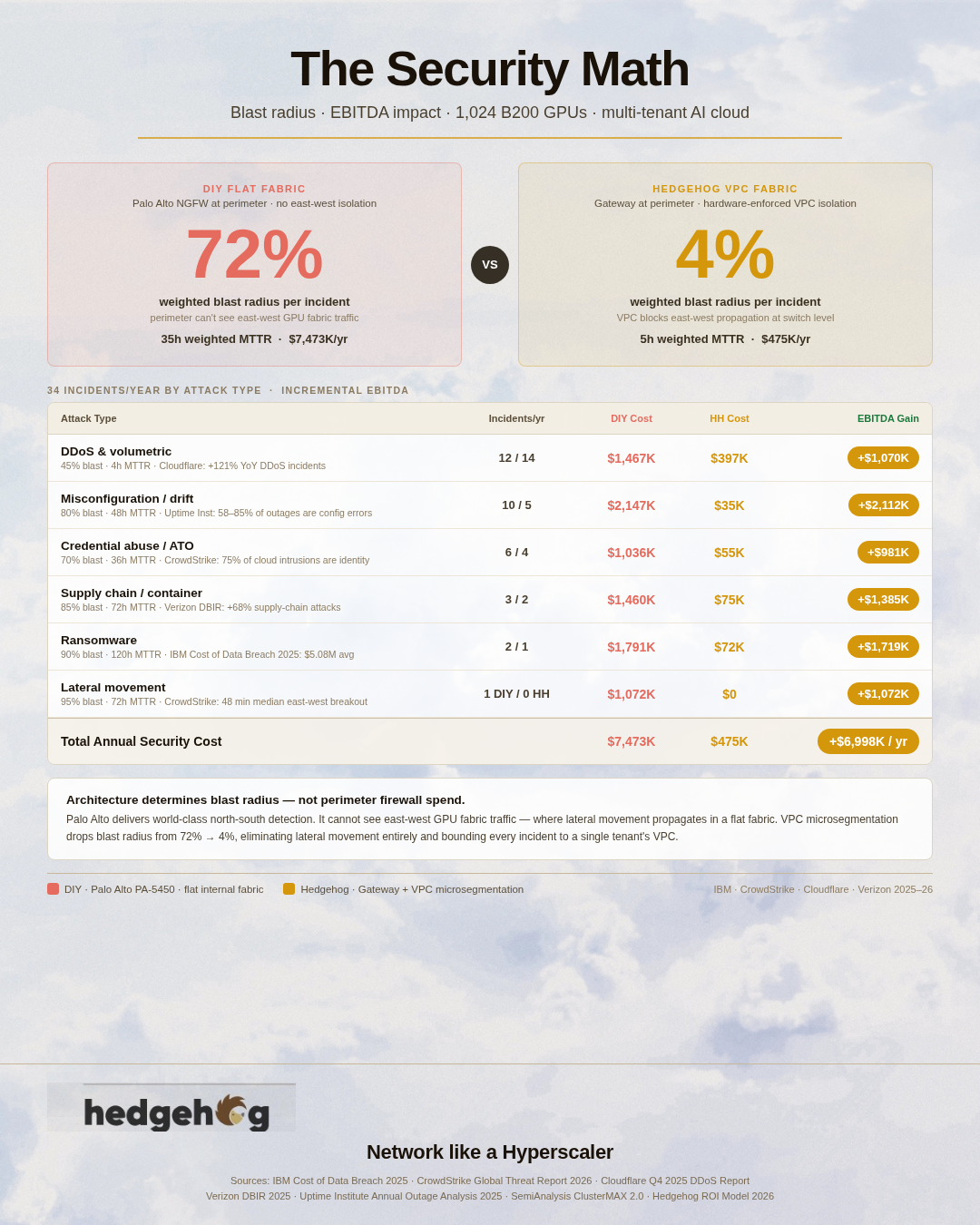
The headline finding for a 1,024-GPU B200 multi-tenant cluster: a Hedgehog-based AI cloud earns approximately $7.0M more per year in EBITDA from security alone compared to a DIY flat-fabric deployment on identical hardware. That gap comes not from Hedgehog having a better perimeter firewall — it doesn't, and this post won't pretend otherwise — but from a fundamental architectural difference in how far any attacker can reach once they're inside.
For the technical detail behind the architecture described here, Hedgehog's Security Whitepaper (available at AI Multitenancy Whitepaper) covers VPC microsegmentation, the Gateway feature set, and the OCP reference architecture in depth.
What Is Multi-Tenant AI Network Security, and Why Is It Different?
A conventional enterprise data center hosts applications that communicate primarily north-south: client requests come in through the perimeter, get processed, and responses go out. East-west traffic — server-to-server, within the data center — exists but is a secondary concern for most applications.
A GPU cluster reverses this. During training and fine-tuning, AllReduce collective operations move data east-west across every GPU in the cluster simultaneously. A 1,024-GPU cluster running a 70B parameter model generates AllReduce traffic at hundreds of terabits per second across the fabric. This traffic is what makes distributed AI training work — and it is completely invisible to a perimeter firewall.
This architectural reality has a direct security consequence: a perimeter firewall, however capable, can see and inspect only what crosses the north-south boundary. Once a threat actor is inside the fabric — whether through a compromised tenant credential, an exposed API endpoint, or a misconfigured container image — the perimeter cannot observe east-west lateral movement at all. In a flat-fabric DIY deployment, a breach of one tenant's workload is, architecturally, a breach of the shared fabric. The blast radius is the entire cluster.
The Hedgehog architecture addresses this by building isolation into the fabric itself, not at the perimeter. Each tenant's workload runs inside a hardware-enforced Virtual Private Cloud. East-west traffic between VPCs is blocked at the switch level unless explicitly permitted. An attacker who compromises one tenant's container cannot traverse the fabric to another tenant's workload — the fabric won't carry the traffic. This is the same architecture hyperscalers use, now available to GPU cloud builders through the Hedgehog reference implementations documented in detail in the Hedgehog AI Multitenancy Whitepaper.
How Many Security Incidents Should a Multi-Tenant GPU Cloud Actually Expect?
More than most operators model. The 2025–2026 threat intelligence corpus points to a baseline rate of approximately 34 material network-impacting security events per year for a multi-tenant GPU cloud at the 1,024-GPU scale, distributed across six attack categories:
DDoS and volumetric attacks: ~12/year. Cloudflare's Q4 2025 threat report documented 47.1 million DDoS attacks across its network — a 121% year-over-year increase. Link11's European Cyber Report 2026 found that more than 70% of organizations targeted once were attacked again, averaging 2.8 follow-up attacks per initial incident. For a GPU cloud with public-facing inference endpoints and customer portals, ~12 material events per year is a conservative baseline.
Misconfiguration and configuration drift: ~10/year (DIY), ~5/year (Hedgehog). Uptime Institute's 2025 Outage Analysis attributes 58–85% of significant outages to procedure failures — operators executing changes incorrectly or skipping required steps. IBM's 2026 X-Force Threat Intelligence Index found a 44% increase in attacks that began with exploitation of public-facing applications. Hedgehog's declarative controller continuously reconciles desired state against actual fabric state, catching configuration drift before it becomes an exploitable opening.
Credential abuse and account takeover: ~6/year. CrowdStrike's 2026 Global Threat Report found identity-based attacks comprised 75% of cloud intrusion activity in 2025. Threat actors increasingly target the management plane — not the GPU workload — as the initial point of entry.
Supply-chain and container image attacks: ~3/year. Verizon's 2025 DBIR found a 68% increase in software supply-chain attacks, including compromised base images distributed through public registries. Multi-tenant GPU clouds running customer-supplied container images have elevated exposure relative to single-tenant deployments.
Ransomware: ~2/year. IBM's Cost of a Data Breach 2025 puts the average ransomware event cost at $5.08M. For multi-tenant GPU infrastructure, leverage is high: a threat actor who can encrypt or exfiltrate a tenant's training checkpoints has an immediately credible ransomware claim.
Lateral movement (east-west): ~1/year at the incident level, but the most consequential category. Once an attacker achieves initial access — through any of the categories above — lateral movement in a flat fabric is unconstrained. CrowdStrike documented a median breakout time of 48 minutes in 2025, down from 62 minutes in 2024. In a flat fabric, the blast radius of a single successful breach can encompass the entire cluster within the hour.
The Perimeter Trade-Off: What Palo Alto Does Well, and Where Architecture Matters More
The typical DIY approach to GPU cloud security is a Palo Alto Networks NGFW pair at the north-south perimeter. A fully configured PA-5450 (200 Gbps throughput with all security services active) delivers world-class north-south inspection: WildFire sandbox, App-ID, User-ID, TLS decryption, Advanced Threat Prevention, and Cortex UEBA integration. For catching threats at the perimeter before they enter the fabric, it is one of the best tools available.
Its limitation is structural, not a product deficiency: it cannot see east-west GPU fabric traffic. The AllReduce traffic that defines GPU cluster operation crosses the fabric at wire speed, inside the data center, and never touches the perimeter. A Palo Alto firewall that correctly blocks 100% of north-south threats still does nothing for a threat actor who gained access through a compromised tenant credential, an API vulnerability, or a container image — all of which originate inside the fabric or establish a foothold before generating north-south traffic the firewall can see.
The Hedgehog Gateway, by contrast, is genuinely more limited as a perimeter device. It provides stateful NAT, ACL-based packet filtering, and DoS protection, with IDS/IPS on the published roadmap. It does not replicate the WildFire sandbox or the application-awareness layer that Palo Alto has spent years building. This is a real feature gap, and the security math in this post accounts for it honestly: the Hedgehog configuration has modestly higher exposure to DDoS events and north-south application attacks.
What Hedgehog does that a perimeter-only architecture cannot is pair the gateway with hardware-enforced VPC microsegmentation in the fabric. Each tenant's workload is isolated at the switch level. East-west traffic between tenants requires an explicit policy exception. The blast radius of any single breach is bounded by VPC — typically one tenant's allocation, not the entire cluster.
The financial consequence of this trade-off is not close. A perimeter firewall pair costs approximately $1.65M in hardware for a 200 Gbps deployment. It cannot contain east-west propagation. A Hedgehog Gateway pair runs on commodity servers (~$40K) and the VPC isolation it pairs with reduces weighted blast radius from 72% of the cluster to approximately 4%. The incremental EBITDA advantage is in the section below.
Translating Architecture Into Annual EBITDA
The following analysis uses a 1,024-GPU B200 cluster operating at 85% utilization, earning Bronze-tier ClusterMAX rates at $6.00/hour per GPU. All incident rates, blast radius estimates, and remediation costs are derived from the primary sources listed at the end of this post.
Annual security cost — DIY flat fabric (Palo Alto perimeter, no east-west isolation)
| Attack Type | Incidents/Year | Weighted Blast Radius | Weighted MTTR | Lost Revenue | IR + Remediation | Expected Ransom | Total |
|---|---|---|---|---|---|---|---|
| DDoS | 12 | 45% | 4h | $1,406,966 | $60,000 | $0 | $1,466,966 |
| Misconfiguration | 10 | 80% | 48h | $2,097,152 | $50,000 | $0 | $2,147,152 |
| Credential abuse | 6 | 70% | 36h | $916,258 | $120,000 | $0 | $1,036,258 |
| Supply chain | 3 | 85% | 72h | $1,119,744 | $240,000 | $100,000 | $1,459,744 |
| Ransomware | 2 | 90% | 120h | $991,232 | $300,000 | $500,000 | $1,791,232 |
| Lateral movement | 1 | 95% | 72h | $372,058 | $180,000 | $520,000 | $1,072,058 |
| Total | 34 | 72% weighted | 35h weighted | $6,903,410 | $950,000 | $620,000 | $7,473,003(est.) |
(Revenue loss formula: incidents × blast radius × MTTR × GPU-hours/hour × $/GPU-hour. B200 at $6.00/hr, 85% utilization, 1,024 GPUs.)
Annual security cost — Hedgehog (Gateway + VPC microsegmentation)
| Attack Type | Incidents/Year | Weighted Blast Radius | Weighted MTTR | Lost Revenue | IR + Remediation | Expected Ransom | Total |
|---|---|---|---|---|---|---|---|
| DDoS | 14 | 10% | 4h | $368,640 | $28,000 | $0 | $396,640 |
| Misconfiguration | 5 | 4% | 12h | $14,746 | $20,000 | $0 | $34,746 |
| Credential abuse | 4 | 4% | 8h | $6,554 | $48,000 | $0 | $54,554 |
| Supply chain | 2 | 4% | 12h | $4,915 | $60,000 | $10,000 | $74,915 |
| Ransomware | 1 | 4% | 12h | $2,457 | $60,000 | $10,000 | $72,457 |
| Lateral movement | 0* | 4% | — | $0 | $0 | $0 | $0 |
| Total | 26 | 4% weighted | 5h weighted | $397,312 | $216,000 | $20,000 | $475,044(est.) |
*Lateral movement as a distinct incident type is effectively eliminated by VPC isolation. The initial compromise events (credential abuse, supply chain) still occur at reduced rates due to lower misconfiguration exposure; the propagation vector is removed.
Incremental EBITDA from security architecture
| DIY Annual Security Cost | Hedgehog Annual Security Cost | Annual EBITDA Gain | |
|---|---|---|---|
| 1,024-GPU B200 cluster | $7,473,003 | $475,044 | +$6,997,959 |
This $7.0M annual EBITDA improvement does not include the capital cost comparison (the $1.65M Palo Alto pair versus the ~$40K Hedgehog Gateway pair), which adds another ~$1.6M in one-time capex savings on day one.
The key driver of the gap is not the perimeter feature comparison — it is the blast radius. A 72% weighted blast radius in the DIY case means that, on average, a significant fraction of the cluster is affected by each material security incident. VPC isolation at the switch level reduces that to 4%. That structural change — bounded blast radius — is what delivers the EBITDA difference. The perimeter firewall comparison is secondary.
Contextual Observations
Ransomware leverage is asymmetric in multi-tenant environments. In a flat-fabric cluster, a ransomware actor who compromises one tenant's container has de facto access to the AllReduce fabric and can, with a credible threat of disruption to other tenants, demand significantly higher ransom than in a single-tenant environment. VPC isolation eliminates this cross-tenant leverage. A contained breach is a contained negotiation.
DDoS costs increase modestly with Hedgehog. The tables above model slightly more DDoS incidents (14 versus 12) for the Hedgehog case, reflecting the honest feature gap between Gateway and a dedicated NGFW for volumetric north-south attack mitigation. The perimeter feature gap is real, and is accounted for here. The 4% blast radius still results in dramatically lower total cost because even the DDoS blast is bounded to a small fraction of the cluster.
The security gap compounds with cluster scale. The blast radius is a percentage of total cluster revenue. As clusters grow from 1,024 to 4,096 to 8,192 GPUs, the EBITDA impact of the 72%-versus-4% blast radius difference scales proportionally. The architecture advantage does not dilute with scale — it amplifies.
Security and reliability interact. The Reliability Math post in this series established that network-attributable incidents in a DIY cluster cost approximately $1.5M per year. Security events that cause network disruption compound both. A ransomware event that encrypts switch configuration files is simultaneously a security incident and a reliability incident. The VPC architecture that limits blast radius in the security case also limits fault propagation in the reliability case.
What This Means for AI Cloud Builders
Network security for a GPU cloud is not a firewall procurement decision. It is an architecture decision. The question is not whether to buy a good firewall — it is whether the fabric itself enforces isolation, or whether isolation is purely a perimeter concern.
Perimeter-only security is a legitimate strategy for east-west-light workloads where application traffic is predominantly client-server and north-south. It is not a viable strategy for a multi-tenant GPU cluster where the AllReduce fabric moves petabytes of training data horizontally across every GPU in the cluster. The perimeter cannot see that traffic. The blast radius cannot be bounded by a device the traffic never traverses.
The Hedgehog reference architecture — open fabric with hardware-enforced VPC isolation at the switch level, paired with a simpler commodity Gateway at the perimeter — is described in the Hedgehog AI Multitenancy Whitepaper. The whitepaper covers the VPC policy model, the Gateway feature set and roadmap, the OCP reference architecture, and the configuration management approach that prevents misconfiguration-driven drift. It is designed for AI cloud operators evaluating the architectural options rather than a marketing overview.
The incremental EBITDA from this architecture choice — approximately $7.0M per year on a 1,024-GPU B200 cluster — is one of three major operating economics advantages quantified in this series. The Performance Math post covers the $5.4M/year MFU penalty that DIY fabrics impose through network underperformance. The Reliability Math post covers the $1.5M/year reliability gap. Together, the three EBITDA contributions total approximately $14.4M per year on a 1,024-GPU B200 cluster, on top of ~$3.8M in one-time capex savings. That is the full financial case for the network architecture decision.
Model Your Own Scenario
Every cluster is different. Attack rate assumptions, blast radius outcomes, and remediation costs vary by geography, customer profile, compliance requirements, and cluster size. The Hedgehog AI Cloud Business Planning Playbook (available at hedgehog.cloud/playbook) lets you model security economics alongside all six operating cost dimensions — design, procurement, deployment, time-to-GPU-value, operations, performance, reliability, and security — for any combination of the nine accelerators in this series, at cluster sizes from 64 to 8,192 GPUs.
The model is available as both a web-based wizard and a downloadable Excel workbook with every formula visible and every assumption editable. If your incident rate assumptions, customer profile, or risk tolerance differ from the defaults used here, the model is built to reflect your actual situation rather than a generic benchmark.
Sources
- IBM Security (2025). Cost of a Data Breach Report 2025.Average breach cost $4.44M; ransomware $5.08M; cloud environments higher than on-premises average. Misidentified/delayed breach detection adds $1.1M above mean.
- IBM Security (2026). X-Force Threat Intelligence Index 2026.Identity-based attacks 75% of cloud intrusions; 44% increase in exploitation of public-facing applications; 48-minute median east-west breakout time.
- Cloudflare (2025). Q4 2025 DDoS Threat Report. 47.1M DDoS attacks mitigated; 121% YoY increase; AISURU botnet 5.76M devices, 6 Tbps peak.
- Verizon (2025). Data Breach Investigations Report 2025. 68% increase in software supply-chain attacks; container image compromise vectors; multi-tenant cloud elevated exposure.
- CrowdStrike (2026). Global Threat Report 2026. Identity-based intrusions 75% of cloud activity; 48-minute median breakout time (from 62 minutes in 2024); cloud-specific threat actor taxonomy.
- Link11 (2026). European Cyber Report 2026. 70%+ repeat targeting rate; 2.8 average follow-up attacks per initial DDoS incident.
- Uptime Institute (2025). Annual Outage Analysis 2025. 58–85% of outages attributable to procedure failures; configuration drift as primary AI workload disruption vector.
- Palo Alto Networks. PA-5450 Series Datasheet. 200 Gbps firewall throughput (189 Gbps with full threat prevention enabled); WildFire sandbox, App-ID, User-ID, Content-ID, Advanced Threat Prevention, TLS inspection. Available at paloaltonetworks.com.
- Hedgehog (2025–2026). Security Whitepaper; Gateway Documentation; Networking Field Day 38 Presentation. VPC microsegmentation architecture; Gateway feature set (stateful NAT/ACL/firewall, DoS protection; IDS/IPS on roadmap); OCP reference architecture. Available at AI Multitenancy Whitepaper.
- SemiAnalysis (November 2025). ClusterMAX™ 2.0. Networking and security criteria; B200 GPU pricing ($6.00/hr Bronze tier); 1,024-GPU cluster revenue model.