
Case Study
Midokura reduced time-to-GPU from months to hours with Hedgehog
The Challenge
Midokura, a Tokyo-based Sony Group company, builds sovereign AI infrastructure for enterprises and public institutions in Japan and beyond.
Its AI Factory as a Service gives customers the frictionless developer experience of a public cloud — running entirely on private, on-premises hardware they control.
That sovereignty promise is why customers choose Midokura: organizations with proprietary datasets increasingly can't — or won't — move them into hyperscale clouds. Delivering on it meant building a multi-tenant platform where enterprise clients run isolated training and inference workloads on shared bare-metal GPU clusters, with low-level infrastructure hidden behind a simple UI and API.
The application layer was manageable. The network was the bottleneck: manual fabric configuration, complex tenant isolation on bare metal, and synchronized AI traffic patterns that overwhelm conventional networks and stall GPUs when packet loss or congestion occurs.
The Solution
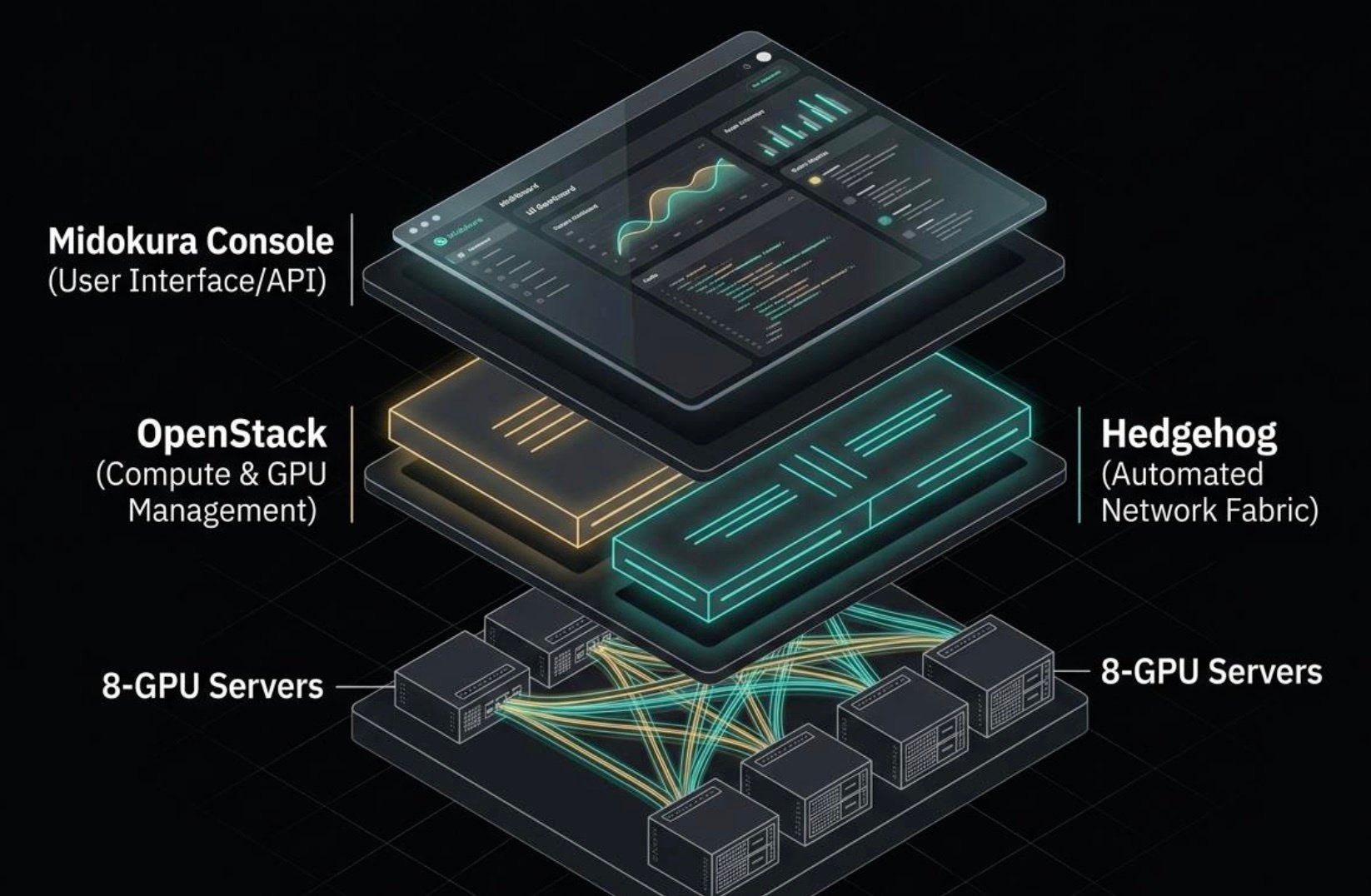
Midokura partnered with Hedgehog to automate its physical network fabric and remove the burden of manual switch configuration.
Using Kubernetes-native YAML and CRDs, the team now declares network intent once, and Hedgehog translates it into BGP underlay, VXLAN segmentation, and tenant isolation across the fabric.
This fit Midokura’s GitOps workflow and gave the platform a consistent, version-controlled way to replicate environments. Hedgehog also configured lossless RoCEv2 networking out of the box, keeping GPU traffic moving efficiently while avoiding vendor lock-in through SONiC and multi-vendor white-box hardware.
Critically for a sovereign platform, tenant isolation is enforced in the fabric itself — in switch ASICs and SmartNICs, not host software — so every tenant boundary is auditable at the wire level.
Data Sovereignty
Why this matters for sovereign AI
Japan's enterprises and public institutions are investing heavily in sovereign AI — infrastructure where proprietary data never leaves their control. Multi-tenancy is the hard part: sovereignty claims are only as strong as tenant isolation.
By enforcing isolation in the network hardware itself, Midokura offers its customers separation they can verify, not just trust.
At-a-Glance

COMPANY
Midokura, a Sony Group company
HEADQUARTERS
Tokyo, Japan
INDUSTRY
AI Infrastructure
SCALE
Multi-GPU bare-metal clusters (8+ GPUs/server), spine-leaf fabric
HARDWARE
White-box switches with Broadcom ASICs, multi-NIC / SmartNIC GPU servers
PRODUCTS USED
Fabric, VPC isolation, RoCEv2 QoS automation
WEBSITE
CUSTOMER VIDEO
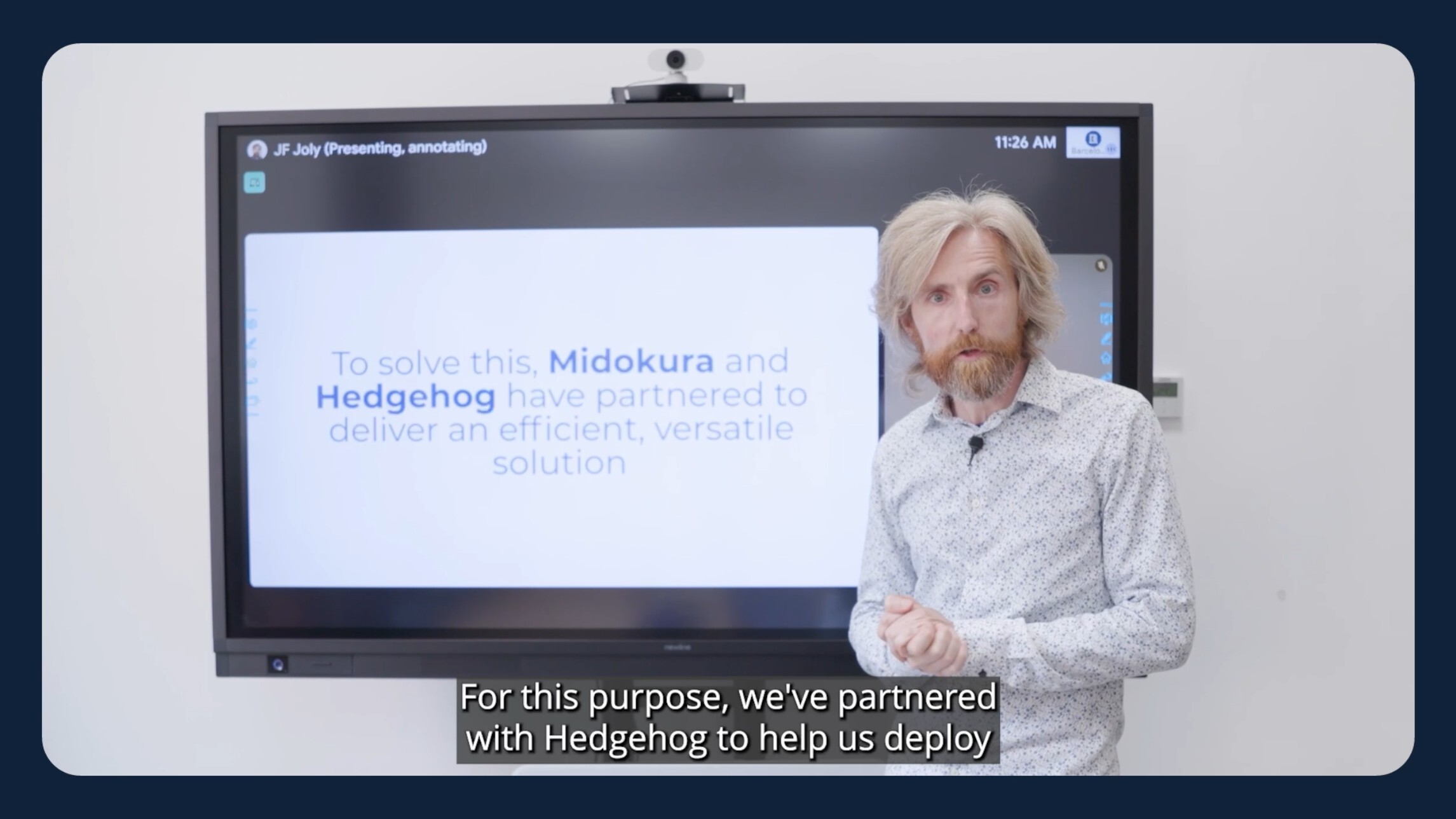
Midokura discusses how they use Hedgehog to manage their network fabric.
Dam Dimitri
Founder & CTO, Midokura
HOW MIDOKURA BUILT IT
Read Midokura's own engineering deep-dive on automating their switch fabric with Hedgehog and SONiC.
Engineering an Automated Switch Fabric With Hedgehog and Sonic
Results
Vendor Lock-in Eliminated
Since Hedgehog runs on SONiC and works across white-box hardware, Midokura can mix vendors instead of being tied to a proprietary switch stack.
GPU's Fed, Not Stalled
Hedgehog configures lossless RoCEv2 fabric behavior for GPUDirect out of the box, keeping expensive GPUs training instead of waiting on retransmits.
Reduced Time to GPU Value
Hedgehog enabled Midokura to reduce deployment time from months to hours by automating the fabric and removing manual switch-by-switch work.
“By relying on Hedgehog to absorb the complexity of the network fabric, our engineering team can focus 100% of our energy on where we add the most value —building world-class software abstractions and developer experiences for AI practitioners."