
3 min read
Podcast - Adopt the Principles, Not the Architecture with Rebecca Weekly
 Marc Austin
:
November 6, 2026
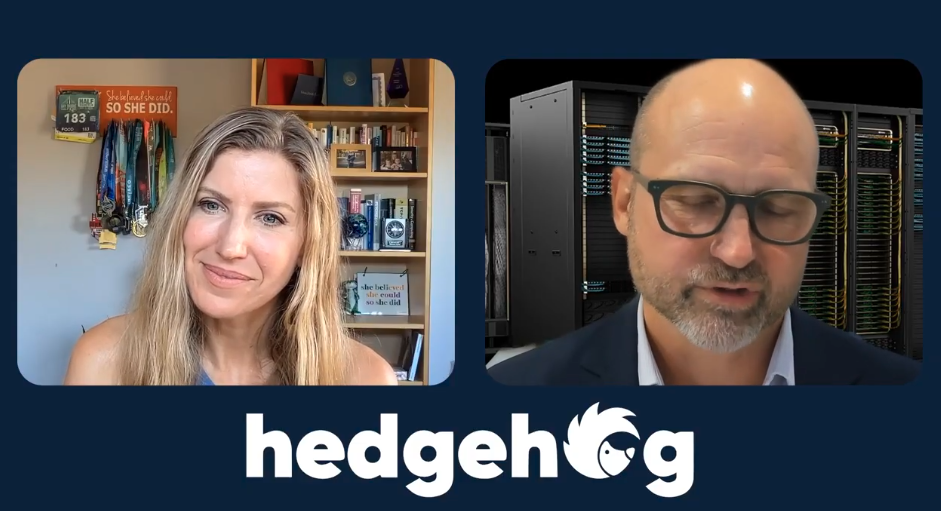
Few people have worked across as many layers of the technology stack as Rebecca Weekly, whose experience spans semiconductors, hyperscale infrastructure, and enterprise IT. She led infrastructure engineering at Cloudflare, chaired the Open Compute Project (OCP), and oversaw hybrid cloud at GEICO. Today, she serves as CTO for six Berkshire Hathaway companies at brk tech.
Every few years, Rebecca steps into her customers' shoes to hear their feedback firsthand. That perspective is why I invited her onto The AI Hedge.
Different on purpose
The Open Compute Project (OCP) standardizes designs that hyperscalers like Microsoft and Facebook don't consider proprietary. Shared specifications allow suppliers to spread development costs across more customers.
Rebecca pointed to a 600-page ODM catalog to illustrate the problem: every design carries upfront development costs, yet only a fraction achieve high sales volumes. OCP encourages convergence around common designs.
Adopt the principles, not the architecture
At Hedgehog, our mission is to help enterprises network like hyperscalers. I asked Rebecca how they can apply hyperscale practices, and her answer reframed the question: “Enterprises should adopt hyperscale operating principles. They should not copy hyperscale architecture.”
The distinction comes down to the different challenges each environment presents.
“Hyperscale is dealing with the complexity of scale. An enterprise is dealing with the complexity of legacy,” she said. Rebecca outlined five guiding principles:
- Treat infrastructure as a product. Offer a defined menu of options and steer outlier requests toward it. Fewer options mean faster time to market and fewer ways to fail.
- Standardize by default. Uniform design patterns reduce overhead. Nobody wants to spend 60% of their resources keeping the lights on.
- Automate from a source of truth. Infrastructure as code and GitOps capture intent and enable automation.
- Expect failure. Large AI systems fail at predictable rates, so design for detection, containment, and automated recovery.
- Make operations and architecture inseparable. If you can’t observe it, upgrade it, or roll it back, you’re not done.
Open networking gives you control and responsibility
I attended my first OCP Global Summit while working at Cisco, which had just announced SONiC support. I remember thinking, “What the heck is SONiC?” That question eventually led me to found Hedgehog and build an operating model around open networking.
SONiC was designed for hyperscale topologies, which differ from the separate L2 and L3 layers common in enterprise networks. The goal is to avoid vendor lock-in without creating an unmanageable operational burden.
Rebecca has run SONiC deployments herself. She warned that while white-box hardware costs less, enterprises must manage their own templates, software lifecycles, and control planes. “Don’t come to it just thinking it’s about cost,” she said, “because you will get burned.”
That’s where Hedgehog comes in. We test reusable, known-good topologies daily to give enterprises the control of open networking with less operational complexity.
AI starts with people and process
Rebecca emphasized understanding business needs before choosing technology. “Organizations often buy technology that represents who they want to become rather than thinking through who they actually are,” she said.
Rebecca encourages technologists to challenge proposed solutions rather than settle for the closest fit. Otherwise, teams force business processes into unsuitable tools and add integrations to compensate. “Technology exposes the operating model you have,” she said.
Open weight, open source, and data sovereignty
Rebecca distinguished between open source and open weight AI models. Open source models make their code publicly available, while open weight models provide access to trained parameters so enterprises can run and fine-tune them.
Open weight models also give enterprises more control over costs, data, compliance, and latency. Rather than paying per token, they can optimize models for specific workloads and run them on private infrastructure. Our customer Zipline supports data sovereignty and reduced infrastructure costs by 70%.
How to hedge enterprise AI risk
I asked Rebecca to identify the biggest risks enterprises face with AI. She highlighted three priorities to help organizations maintain control over their AI infrastructure as their requirements, workloads, and model options evolve:
- Retain control of business context and data. Protecting these strategic assets makes data sovereignty essential.
- Extend identity and access controls to AI agents. If agents take real actions, enterprises need real-time observability and the ability to stop them immediately.
- Deploy an AI gateway. This is the most important hedge. An AI gateway routes workloads to appropriate models and locations while governing and monitoring traffic. It also reduces exposure to changes in proprietary model pricing.
From experiment to production
Rebecca emphasized distributed systems discipline as AI moves into production. Inference economics require careful resource management, while identity must extend beyond humans to AI agents, with projects like SPIFFE and SPIRE supporting cryptographic workload identities. Hybrid multi-cloud infrastructure can help manage capacity constraints and avoid dependence on individual providers.
Hedgehog's networking platform operates across on-premises infrastructure, major hyperscalers, and neoclouds simultaneously.
Listen to the full episode of The AI Hedge and explore our OCP reference architectures for AI training and inference to learn more about networking like a hyperscaler.