
1 min read
Kubernetes for AI Workloads: When Perfect Scheduling Meets Imperfect Networks
Why Your Advanced Kubernetes AI Scheduler Might Be Fighting a Losing Battle If you work with AI infrastructure, manage Kubernetes clusters for...
3 min read
Marc Austin
:
Updated on August 28, 2026
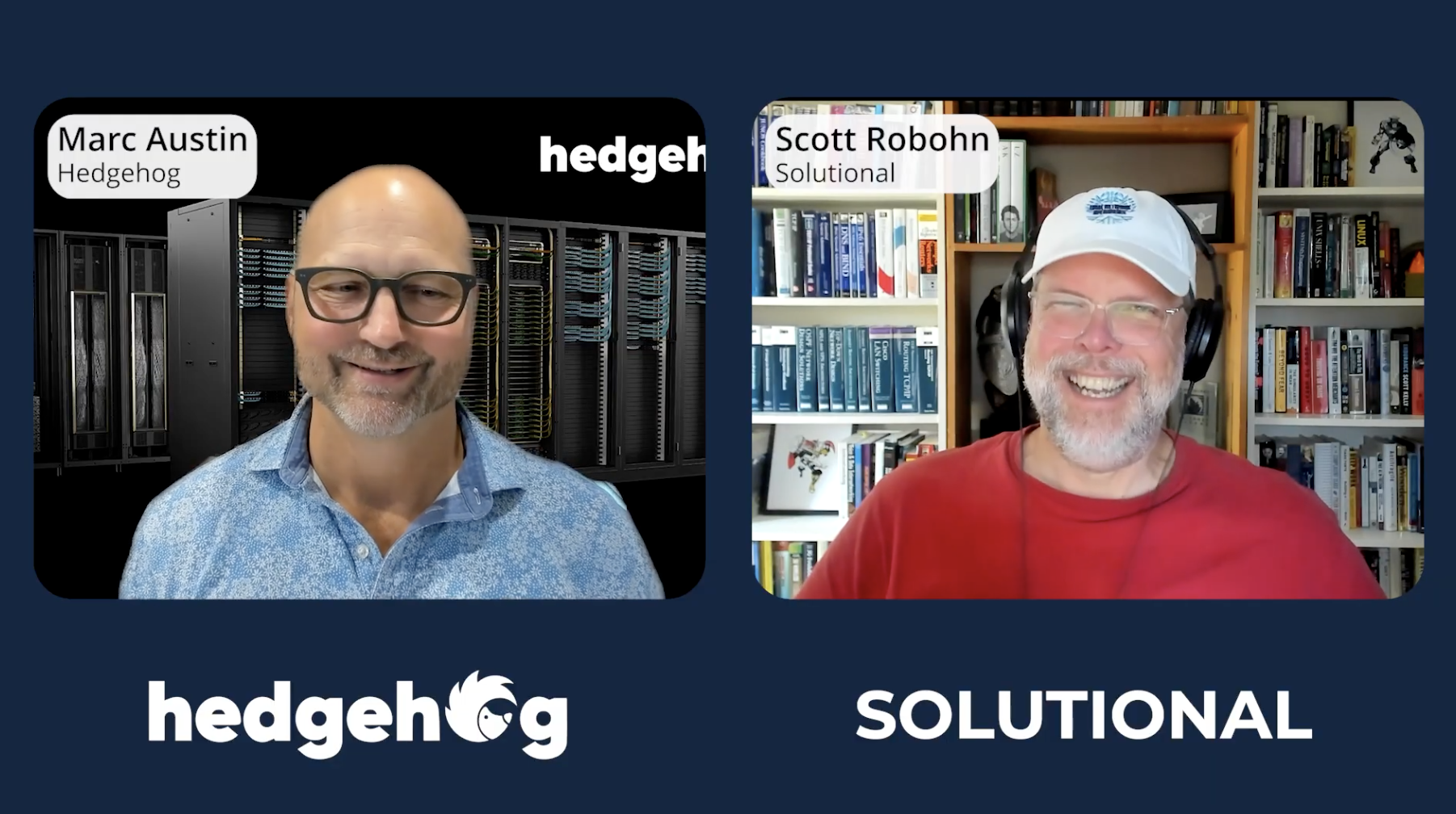
On a recent episode of “The AI Hedge,” I sat down with Scott Robohn, consulting CTO for Carahsoft and co-founder of the Network Automation Forum, to talk about what it takes to build and operate AI networks at scale. Scott has spent 37 years in networking, from an early stint at one of the Baby Bells through Juniper, Cisco, Nokia and DriveNets, and now runs his own consulting practice, Solutional.
Scott co-founded the Network Automation Forum (NAF) with Chris Grundemann in early 2023, not long after Scott left corporate work to start consulting.
Both longtime automation practitioners, they wanted to find out why traditional network engineers, “trad net engs,” were hesitant to automate because of worries they would lose their jobs.
Getting people together to talk about it led to the NAF’s AutoCon 0 that November in Denver. They had hoped for 200 people and got about 345, a signal that the topic resonated.
The event has continued every year since; AutoCon 5 drew crowds to Munich this past June, and AutoCon 6 is set for Tucson, Arizona, this November.
Cloud and AI-resource networking remain underrepresented there, Scott said, which presents an opening for my company, Hedgehog.
We talked about Scott’s consulting work for Carahsoft, one of the largest federal software resellers, and the U.S. government’s own AI push. His work with the company involves data center solutions, AI model partnerships and AI networking.
I shared that I’d just come from meeting with the sales team at Carahsoft, where opportunities were coming in faster than we could respond to them.
“So it sounds like the government is building out AI infrastructure at scale,” I said. He agreed.
That pace of demand holds up only through automation, and I’d seen it firsthand. The day before recording this podcast, I’d talked with an operator at the Defense Information Systems Agency (DISA), the Defense Department’s IT organization, who was using AWS GovCloud and Outposts for a hybrid cloud solution, all managed with infrastructure as code and GitOps.
The operator was early career and trained on NetDevOps, what Scott defines as “the smart application of DevOps principles to the networking domain,” rather than doing traditional network engineering. I asked Scott whether that was becoming the norm.
Scott said yes and then pointed to an industry problem: The NetOps community is aging. There’s a shortage of new cloud-first talent to replace that aging trad net eng workforce. Scott’s podcast interviews with neocloud and AI data center providers have turned up the same complaint.
The good news, Scott said, is that automation can help close that gap without reducing the need for people: “I can be Tony Stark in the Iron Man suit. … I’m still the human in control, but the suit lets me do a lot more.”
His advice for newcomers: Get grounded in basic networking, understand why Python and CI/CD matter, learn the principles of one of the main cloud platforms, and use AI tooling as a patient tutor.
I asked Scott whether it’s smart to let AI configure a network alone. I’d framed the choice as deterministic versus probabilistic: infrastructure as code and GitOps versus AI reasoning. Scott agreed that you need both: deterministic automation to guarantee outcomes, and agentic reasoning where scripts won’t work.
“I need the Roomba to bounce around the room sometimes when I don’t have great problem definition,” Scott said.
I mentioned that I sold closed-loop network automation at Cisco for six years, and that AI Ops predates chatbots: Machine learning correlates logs into incidents, and an automation API closes the loop, ideally with a human watching. But if you skip that and just tell an AI to configure the network, what happens?
Scott’s answer was spec-driven design, a discipline older than AI but now paired with it: In his own test, an AI walked him through six rounds of questions to nail down a spec before generating infrastructure as code for a cloud setup.
Hedgehog’s engineers use Claude Code to move faster, but we test every configuration before production, the same NetDevOps principle Scott described, now applied to AI-generated configs.
Scott’s conversation traces the shift from traditional networking to cloud-first automation. NAF formed in response to traditional engineers hesitating to trust automation with their careers.
The early-career DISA operator I met is proof the shift is underway. Closing that gap between an aging workforce and a shortage of cloud-first newcomers is the industry’s most urgent problem, one Scott’s advice aims to solve.
That same NetDevOps discipline, deterministic automation paired with agentic AI reasoning, is what Scott sees the industry converging on: automation as a first language at AI scale.
To learn more, listen to the full episode of “The AI Hedge,” visit http://networkautomation.forum or find Scott Robohn on LinkedIn.
1 min read
Why Your Advanced Kubernetes AI Scheduler Might Be Fighting a Losing Battle If you work with AI infrastructure, manage Kubernetes clusters for...
1 min read
Why Traditional Networks Fail AI Workloads The billion-dollar bottleneck hiding in your artificial intelligence infrastructure
1 min read
Intelligent Industrial Automation: Smarter, Faster, and More Cost-Effective Businesses in many different industries rely heavily on industrial ...