
1 min read
The AI Networking Revolution: Dawn of a New Epoch
When we look back at the history of networking, it's clear that the industry moves in distinct epochs. These technological eras aren't merely defined...
9 min read
Marc Austin
:
Updated on June 25, 2026
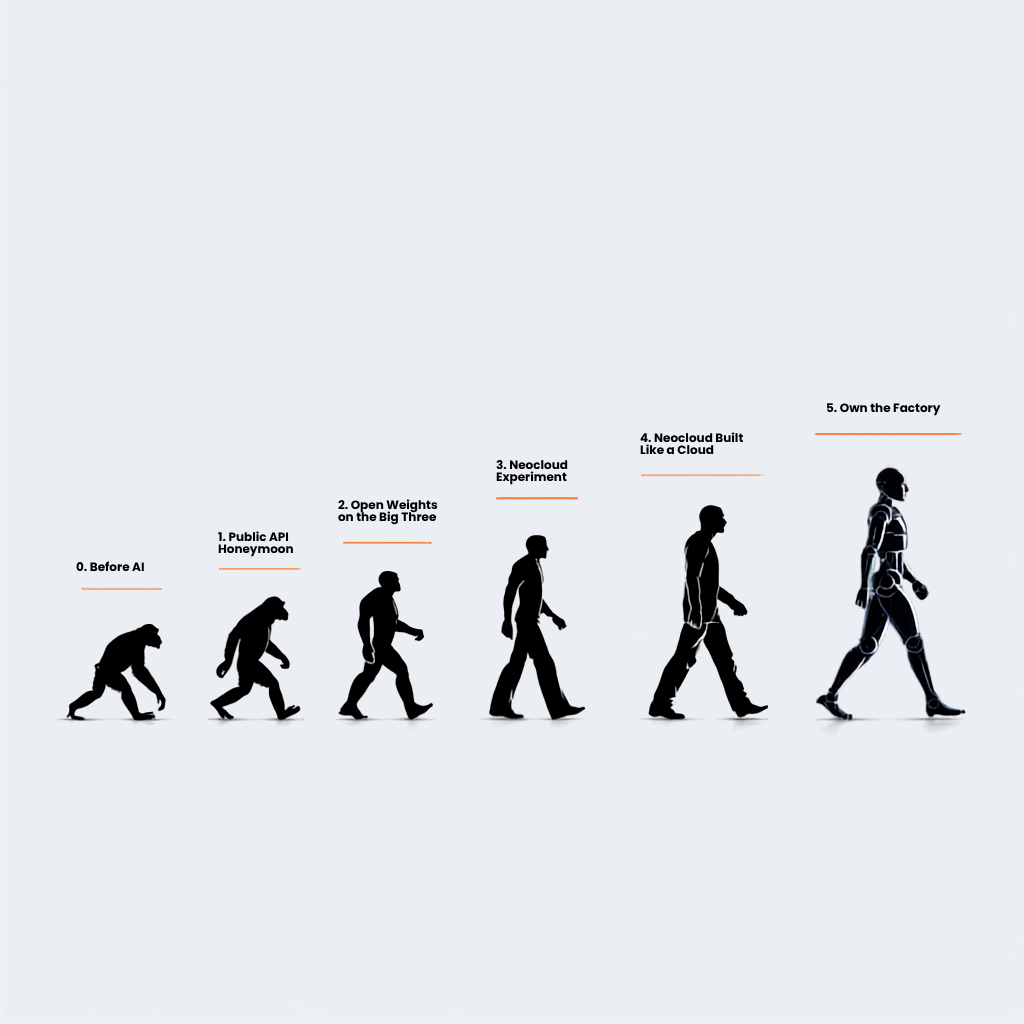
Every enterprise we talk to is somewhere on the same road. The faces in the boardroom change, the industry changes, the model du jour changes — but the arc does not. It starts with a CEO declaring “we need to do AI.” It ends, eventually, with a sober conversation about owning the AI factory that produces the company’s intelligence advantage.
What most maps of this journey miss is that there are two journeys happening at once. The first is operational: copilots and productivity tools — AI that makes the company cheaper to run. The second matters more: AI built into the products the company sells. The first shows up as Operating Costs. The second shows up as Cost of Good Sold (COGS) — and when inference cost scales with every customer interaction, AI economics stop being an IT line item and start setting your gross margin.
This post maps the five phases of that journey. If you recognize yourself in Phase 1, this is a preview of what’s coming. If you’re already in Phase 3, this is permission to admit it.
|
Phase |
What it looks like |
Who feels the pain |
The bill that ends it |
|
1 |
Everything runs on frontier APIs |
CFO, CSO |
Token opex + AI-product COGS + proprietary data leaving the company’s control |
|
2 |
Open weights in your hyperscaler VPC |
CFO, CIO |
2–3x GPU premium + per-GB egress lock-in |
|
3 |
Neocloud GPUs, DIY everything else |
CTO, CSO |
Two quarters of platform engineering + security gaps |
|
4 |
Neocloud with a real cloud network (Hedgehog) |
CFO |
~20% third-party AI platform tax |
|
5 |
Own the factory: your infrastructure, Hedgehog network + platform |
— |
This is the destination |
The CEO returns from an offsite, a customer dinner, or a board meeting and declares the new mandate. The CTO is tasked with developer adoption, the CMO with content, sales gets a copilot pilot, legal gets a research assistant. And — quietly at first — a product team ships the company’s first AI feature: an assistant inside the app, a natural-language interface, an AI summarization layer. All of it runs on frontier APIs, because that is where everyone starts.
For a while, this feels like flying. Productivity climbs. Customers actually use the new feature. The CEO tells the board the company is “AI-native now.”
Then two bills and a memo arrive.
The CFO’s first bill is opex. Token spend, which started as a rounding error, has become a real line item. A few hundred power users running agentic workflows, RAG over internal documents, and long-context summarization can push monthly API spend into six and seven figures — metered consumption with no committed-use discount and no FinOps playbook.
The CFO’s second bill is worse, because it’s COGS. The AI product feature worked. Usage now scales with customers — which means inference cost scales with revenue, and at frontier API prices every new customer arrives with a per-token royalty attached. The gross margin on the company’s first AI product is being set by a vendor’s price list. Pricing strategy meetings start including the phrase “tokens per session.”
The CSO’s memo is shorter. It explains, in the careful language security officers use when they want the executive team to actually read something, that nine months of the company’s crown jewels — its proprietary data: pricing strategy, M&A targets, source code, customer lists, unreleased roadmaps — have been crossing a vendor boundary. The provider’s terms likely promise not to train on API traffic, and that promise is probably kept. That isn’t the point. The data traversed infrastructure the enterprise neither owns nor audits, sat in someone else’s logs, under someone else’s retention policy. In regulated industries, the memo has a second paragraph about contract clauses and a third about regulators.
The conversation that ends Phase 1 usually contains some version of the line: “It’s the data, stupid.” Confidential data is the company’s only durable advantage in the AI era — the one thing competitors cannot replicate, and the raw material of every differentiated AI product it will ever ship. And it has been flowing across a vendor boundary because the API was easy.
Phase 1 ends with a decision: bring the model to the data, not the data to the model.
The CTO’s team gets a new charter: stand up an enterprise AI stack on AWS, Azure, or GCP — wherever the cloud footprint already sits. The pitch writes itself: “We already trust the hyperscaler with our data. We’ll run open-weight models in our own VPC. Same security envelope as the rest of the business.”
The team imports the corpus into the cloud data platform, evaluates open-weight models — Llama, Mistral, Qwen, DeepSeek, gpt-oss — builds RAG against proprietary documents, and fine-tunes. And something important happens: for narrow, high-value tasks — contract review, support triage, and crucially the AI features inside the product — the fine-tuned open model starts beating the frontier APIs on the metrics that matter. The product team now has a model competitors can’t call, trained on data competitors don’t have. For the first time, the company owns differentiated AI rather than renting undifferentiated AI — and the per-token royalty is gone; inference cost is now infrastructure cost.
For a quarter or two, this looks like the answer. Then the CFO gets the next bill.
Hyperscaler GPU pricing carries a structural premium — typically two to three times what specialist GPU providers charge for the same silicon. A modest production deployment — a couple of 8-GPU nodes for inference plus periodic fine-tuning bursts — clears six figures a month before storage, networking, and managed services. And because the AI product is growing, the inference fleet grows with it. The COGS problem hasn’t gone away; it has changed landlords.
The CFO asks for an optimization plan. The CIO comes back with the number nobody wants to look at: the cost of getting the data out. Hyperscaler internet egress runs roughly $0.05–$0.12 per GB depending on provider and volume — call it $50,000 to $90,000+ to move a petabyte, before cross-region replication, NAT processing, and inter-AZ transfer fees compound it. For AI workloads — where that proprietary data is repeatedly re-embedded, re-indexed, and re-trained — data transfer is a materially larger share of the bill than for classic workloads.
The second uncomfortable conversation of the journey: the company didn’t give the farm to the model vendors — it gave it to the hyperscaler. The data is expensive to move, the GPUs are structurally premium, and every byte that wants to leave is monetized.
Phase 2 ends with a new question: is there a cheaper place to run this — without the egress tax?
On the surface, yes. The neoclouds were built for exactly this: dense GPU fleets, fast back-end interconnects, free or near-free egress increasingly standard, and pricing that undercuts the hyperscalers dramatically — for a production inference fleet, the difference compounds to hundreds of thousands of dollars per node per year, and a 16-node fleet becomes a seven-figure annual swing. On paper, the case closes itself.
The team migrates. And then it discovers what it bought.
The network gap. Neoclouds invested where the training benchmarks live: the back-end fabric — InfiniBand, rail-optimized topologies, GPUDirect RDMA. They did not invest in the front end. The foundational cloud network services an enterprise takes for granted — VPC isolation, security groups, managed routing into the corporate WAN, firewalls, load balancing — are missing, half-implemented, or bring-your-own. This should surprise no one: the hyperscalers took years and billions of dollars to build those capabilities. AWS went as far as acquiring an entire chip company, Annapurna Labs, and building its Nitro system to deliver cloud networking in custom silicon. A neocloud racing to stand up GPU capacity is not going to recreate that investment on the timeline the enterprise needs it. So the platform team spends the next two quarters building the cloud it thought it was buying: open-source policy engines, load balancers, firewalls, custom BGP, and the Terraform glue to hold it together. Every connection back to the data lake, the VPN, the identity provider is a custom integration. The savings start getting eaten by a platform team that wasn’t in the business case.
The security gap. The CSO’s audit finds tenant boundaries enforced by the scheduling software rather than the network, and management planes exposed in ways the hyperscalers stopped tolerating years ago. The starkest finding is east-west traffic: data moving laterally between workloads — including other customers’ workloads — on the same GPU cluster, often unencrypted and uninspected. The hyperscalers encrypt this traffic at multiple layers as a matter of course; most neoclouds do not, and without the network investment described above, realistically never will. Compliance posture varies widely across providers. For internal workloads, this is uncomfortable. For product workloads serving customer data, it can be disqualifying.
The due-diligence question. Many neoclouds are young, highly leveraged businesses financing enormous capex against multi-year contracts — a structure that works until it doesn’t, and a market that will consolidate. The CFO’s checklist gets longer: What does the provider’s balance sheet look like? How concentrated is its customer base? And the question that matters most: if this provider is acquired, restructured, or fails, what happens to our fine-tuned models, our embeddings, and our customer-facing inference traffic? These risks are manageable — but only if you ask before you migrate, and only if your architecture is portable enough to move.
Phase 3 ends with a hard-won realization: the neocloud GPU economics are right, but the cloud around the GPUs is missing. AI needs a real cloud network — without handing the GPU savings back to get one.
This is where Hedgehog enters the story. In Phase 4, the enterprise finds a neocloud — or pushes its provider to become one — whose network is built on Hedgehog: Hedgehog VPC, which enforces tenant isolation in the network itself and provides the familiar cloud networking controls — private networks, routing, security groups — that behave exactly as the enterprise’s teams and security policies already expect; and Hedgehog Gateway, which makes ingress and egress a first-class network service instead of a per-GB profit center.
What changes for the executive team:
One residual tax remains. Most neoclouds sell GPUs and storage, not platforms. To get from “we have GPUs” to “we have fine-tuned models serving production traffic,” most enterprises bolt on a third-party AI platform layer — Together AI, Modal, Anyscale, RunPod’s serverless tier, or similar. These platforms are good: model serving, autoscaling, fine-tuning pipelines, observability. They also charge a real premium — commonly around 20 percent on top of the underlying GPU cost. Phase 4 is the right architecture with one remaining toll booth.
In Phase 5, the enterprise crosses the line from renter to owner. The premise, after four phases, is finally obvious: run open-weight models, fine-tuned on our private data, on AI infrastructure we own — powered by the Hedgehog AI Network and the Hedgehog AI Platform.
Let’s be honest about when this trade makes sense, because the obvious CFO objection is real: ownership means capex, power, facilities, and hardware refresh risk. Owning beats renting when you have sustained baseline load — and by the time an enterprise reaches this point, it almost always does: AI product features serving customers around the clock, copilots and RAG across every business unit, a regular fine-tuning cadence. Rent the bursts and the experiments; own the steady-state factory floor. Most Phase 5 enterprises run a hybrid — owned baseline, rented spikes — and the owned baseline is where the economics compound.
Every premium accumulated across the first four phases comes out of the cost structure. The network stops being a markup embedded in someone else’s GPU rate and becomes a flat, predictable cost the enterprise controls. The platform layer — model serving, autoscaling, fine-tuning, observability — stops being a percentage skimmed off every GPU-hour and becomes part of the stack the enterprise owns. Data movement stops being metered at all. The savings are real and quantifiable, but the strategic benefits are larger:
Most enterprises we see are 12 to 18 months into Phase 1 or Phase 2 today. Converging on Phase 5 typically takes another 18 to 36 months of bill shocks, security audits, and architectural rework. The leaders who get there first hold two structural advantages over those still rationalizing Phase 2: a cost advantage on everything AI does inside the company, and a margin-and-data advantage on everything AI does inside their products.
The CEO who started this journey by saying “we need to do AI” eventually says something different: we need to own the means of producing our intelligence. That is the real destination. The five phases are just how long it takes the executive team to agree on it.
Hedgehog builds the AI network and the AI platform for enterprises that have decided to own their AI factory. If you recognize your organization in Phases 1 through 4, we’ll map where you are and model the economics with you — a working TCO comparison of rented APIs, hyperscaler VPC, neocloud, and owned infrastructure, built on your numbers, not ours. The bill shocks are predictable. So is the architecture that ends them.
1 min read
When we look back at the history of networking, it's clear that the industry moves in distinct epochs. These technological eras aren't merely defined...
1 min read
The same AI model can require significant differences in infrastructure depending on whether you're training it or running it. Here's why your...
1 min read
Dell'Oro Group just released their 4Q 2024 Ethernet Switch - Data Center Report showing record-breaking sales fueled by AI buildouts and a recovery...